
Choosing the right Frp Pipe is a technical decision, not a simple price comparison. The correct selection must match fluid chemistry, pressure, temperature, soil conditions, installation methods, and expected service life. A pipe that performs well in a water-treatment plant may fail prematurely in an acidic industrial process. Details matter.
Industry reports show why this market deserves careful evaluation. MarketsandMarkets projects the global fiberglass pipes market to grow from approximately USD 4.1 billion in 2023 to USD 5.4 billion by 2028. The AWWA M45 Fiberglass Pipe Design Manual also emphasizes structural design, hydraulic performance, joining systems, and field installation. These references support a practical approach: compare standards, verify manufacturer data, and inspect actual project experience before approving a product.
Composite materials expert Dr. Scott W. Beckwith has stated, “Composites require disciplined design, manufacturing control, and application knowledge.” That principle applies directly to Frp Pipe selection. The seven tips ahead examine resin compatibility, pressure ratings, stiffness, corrosion resistance, connection design, certification, and supplier support. They also encourage readers to question attractive claims. A lower purchase price may conceal higher installation costs, uncertain testing, or weak technical documentation. Sometimes, the specification itself is incomplete. That is worth admitting.
Look closely at the operating environment. A chemical concentration written on a data sheet may change during cleaning, shutdowns, or temperature spikes. The best Frp Pipe is not always the thickest or most expensive option. It is the one supported by verified calculations, suitable standards, transparent testing, and experienced field service.
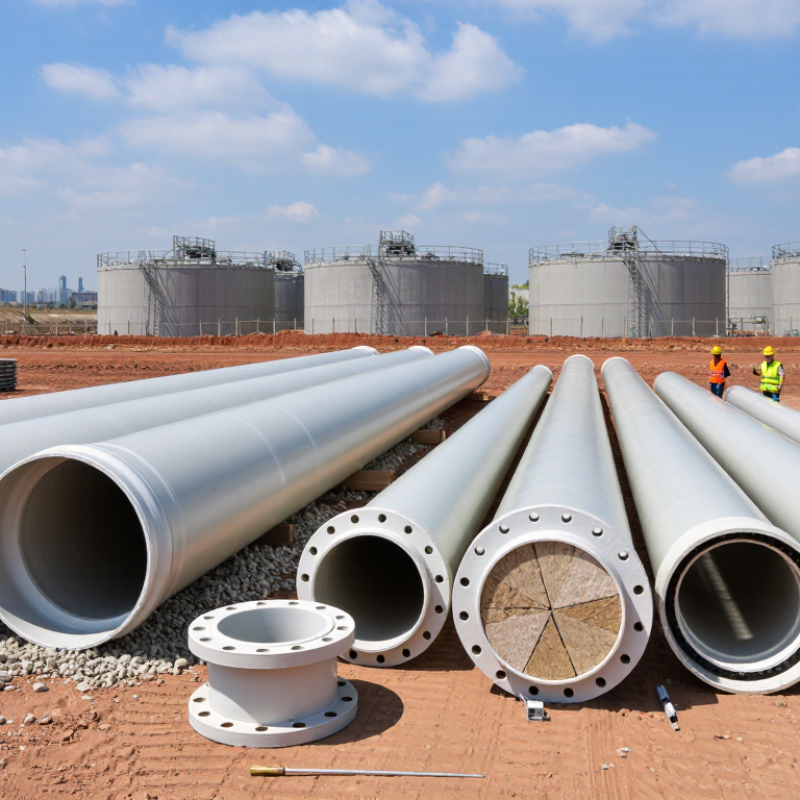
Choosing the right FRP pipe starts with a clear definition of the service environment. Identify the fluid, temperature, pressure, flow rate, and pipe diameter before comparing products. Chemical concentration matters, even when the fluid seems mild. A diluted acid can become aggressive at elevated temperatures. Record operating and upset conditions, not only normal values. Field inspections have taught me that occasional pressure surges often cause more damage than steady pressure. Small details matter.
Tip: Build a written requirement sheet. Include continuous and peak pressure, vacuum exposure, buried or above-ground installation, support spacing, UV exposure, and expected service life. Specify joining methods and acceptable leakage limits. If the pipe carries abrasive slurry, describe particle size and velocity. These factors influence resin selection, wall thickness, liner design, and reinforcement. Guessing here is expensive.
A qualified engineer should review compatibility data, design calculations, and relevant testing records. Ask for evidence covering hydrostatic pressure, stiffness, temperature, and chemical resistance. Standards can guide the process, but they cannot replace application-specific judgment. I once treated a short temperature spike as unimportant; that assumption deserved more scrutiny. Plan inspection access, lifting points, and repair procedures before installation. Tip: Leave room for uncertainty. Real systems rarely behave exactly like spreadsheets.
7 Tips for Choosing the Right FRP Pipe
Compare resin types before comparing prices. Epoxy resin often supports demanding mechanical loads. Vinyl ester resin can offer strong chemical and corrosion resistance. Polyester resin may suit less aggressive services. Confirm compatibility with the actual fluid, temperature, and concentration. A general chemical chart is not enough.
Check the reinforcement schedule carefully. Glass-fiber winding affects hoop strength, stiffness, and pressure performance. A pipe carrying internal pressure needs strong circumferential reinforcement. Buried pipe also needs axial strength and controlled deflection. Ask for fiber orientation, glass content, wall thickness, and joint details. Small details matter.
Review structural calculations, not only catalog ratings. Verify pressure class, vacuum resistance, buckling performance, and support spacing. Consider installation loads, soil conditions, thermal movement, and surge pressure. Request hydrostatic test records and independent inspection data. On a wastewater project, I once found that correct resin selection could not fix poor bedding. That changed my review checklist. I now inspect the whole system, including restraints and connections. It is easy to overtrust a high strength number. Field performance depends on design, workmanship, and maintenance. Choose a manufacturer that explains test methods clearly and supplies traceable material records. Also compare expected service life under real operating conditions, not ideal laboratory conditions.
Use this comparison as a preliminary selection guide. Final pipe design should be verified against the applicable project standard, operating conditions, installation method, and manufacturer-certified calculations.
| Tip | Selection Dimension | What to Compare | Typical Options or Values | How It Affects Pipe Selection | Recommended Verification |
|---|---|---|---|---|---|
| 1 | Define the Service Fluid | Identify the fluid composition, concentration, temperature, pH, abrasiveness, and cleaning chemicals. | Water, seawater, acids, alkalis, brine, wastewater, slurries, and process chemicals. | Chemical compatibility is primarily controlled by the resin and the corrosion barrier. A resin suitable for water may not be suitable for concentrated chemicals or elevated temperatures. | Review the resin compatibility chart for the exact chemical concentration and maximum continuous operating temperature. Consider permeation and liner requirements. |
| 2 | Choose the Resin Type | Compare chemical resistance, temperature capability, toughness, shrinkage, and cost. | Polyester: economical and suitable for many general-purpose water and wastewater services. Vinyl ester: generally offers better resistance to aggressive chemicals, hydrolysis, and higher-temperature service than standard polyester. Epoxy: provides strong adhesion and low shrinkage, and is commonly selected when mechanical performance or demanding chemical service is important. | Resin selection influences corrosion life, interlaminar strength, dimensional stability, and allowable operating temperature. No single resin is best for every service. | Require documented chemical-resistance data, design temperature limits, cure information, and confirmation that the selected resin meets the project specification. |
| 3 | Compare Reinforcement Architecture | Evaluate glass-fiber type, orientation, winding angle, fiber content, and corrosion-barrier construction. | Common reinforcements include E-glass roving, chopped-strand mat, and stitched fabrics. Hoop-oriented fibers improve circumferential strength; helical or axial fibers contribute to longitudinal and combined-load capacity. | Fiber orientation is as important as fiber quantity. A pipe optimized only for internal pressure may require additional axial reinforcement when exposed to thrust, bending, vacuum, seismic movement, or buried-soil loads. | Request laminate construction details, nominal fiber content, winding angles, liner thickness, and test data for axial, circumferential, and interlaminar properties. |
| 4 | Match Pressure and Temperature Ratings | Check internal pressure, external pressure, surge, vacuum, and temperature together rather than separately. | FRP pipes are often specified by pressure class or design pressure, but allowable pressure can decrease as temperature rises. Vacuum resistance depends strongly on stiffness, wall structure, diameter, support, and ovality. | Pressure cycling, water hammer, thermal expansion, and negative pressure can govern the design even when the normal operating pressure is moderate. | Confirm design pressure, test pressure, surge allowance, maximum continuous temperature, short-term temperature limits, and external-pressure or vacuum calculations. |
| 5 | Assess Structural Performance | Review stiffness, buckling resistance, deflection, axial capacity, fatigue, and support spacing. | Key factors include diameter-to-thickness ratio, ring stiffness, laminate modulus, soil support, burial depth, traffic loading, span length, and restraint conditions. | Unlike isotropic metal pipes, FRP properties vary by direction. A pipe can have high hoop strength but insufficient axial or bending capacity if the laminate is not designed for the actual load case. | Request calculations for buried, above-ground, and submerged conditions as applicable. Check allowable deflection, buckling safety factors, support reactions, and joint loads. |
| 6 | Select the Joint System | Compare sealing method, axial restraint, installation tolerance, pressure capability, and maintenance requirements. | Common systems include gasketed bell-and-spigot joints, restrained gasketed joints, flanged connections, and laminated or bonded joints. | Joint performance may control leakage risk and allowable movement. Restrained joints can transfer axial thrust, while flexible gasketed joints may accommodate limited angular deflection when properly installed. | Verify gasket material compatibility, joint pressure rating, allowable angular deflection, insertion depth, thrust-block requirements, and field inspection procedures. |
| 7 | Check Standards, Testing, and Quality Control | Confirm compliance with the required design standard and inspect manufacturing consistency. | Relevant requirements may address dimensions, hydrostatic pressure, stiffness, joint integrity, chemical resistance, workmanship, marking, and long-term design factors. | Product performance depends on resin cure, fiber placement, void content, liner quality, dimensional accuracy, and quality-control testing—not only on nominal material names. | Specify the applicable standard, inspection plan, test frequency, acceptance criteria, traceability records, hydrostatic testing, and documentation for each production lot. |
| Important note: The performance values and material descriptions above are general engineering guidance, not a substitute for project-specific design. Actual allowable pressure, stiffness, temperature rating, chemical resistance, and service life depend on the complete laminate, geometry, manufacturing process, installation conditions, and applicable design standard. | |||||
Evaluate Pressure Ratings, Temperature Limits, and Chemical Resistance
Pressure rating is not a single number. Check the pipe’s operating pressure, surge pressure, vacuum resistance, and cyclic loading. ASTM D2992 uses long-term hydrostatic data to support pressure qualification. Ask for test conditions, safety factors, and failure history. A pipe rated at 150 psi may perform differently after heating, vibration, or repeated pump starts. Design conservatively. A neat spreadsheet can still hide a bad assumption.
Temperature changes the calculation. Review the resin system’s continuous and intermittent limits, then apply the supplier’s derating curve. Consider thermal expansion, rapid temperature swings, and heat transfer through fittings. ISO 14692 provides a recognized framework for fiberglass piping design in energy applications. Still, field conditions rarely behave perfectly. I would verify the highest real temperature, not the normal average.
Chemical resistance requires more than matching a chemical name. Confirm concentration, temperature, exposure time, abrasion, and permeation risks. Liner selection matters when fluids are aggressive or contaminated. AMPP’s IMPACT study estimated global corrosion costs near 2.5 trillion dollars annually, equal to about 3.4% of global gross domestic product. That figure explains why compatibility testing deserves serious attention. Request immersion-test results, preferably under conditions close to service. A quick chart is useful. It is not proof. Review joints, gaskets, and maintenance access as carefully as the pipe wall.
7 Tips for Choosing the Right FRP Pipe
Check the internal diameter, outside diameter, wall thickness, and pressure rating. Small measurement errors can disrupt flow and create difficult field adjustments. Confirm the fluid temperature, chemical concentration, and operating pressure before selecting a pipe. Also check whether the line carries solids, because abrasion can change the required design. Measure the available trench or rack space. A perfect pipe may still fail when access is limited.
Compare joint methods carefully. Flanged connections support inspection and equipment removal, while bonded joints can reduce weight and leakage points. Mechanical couplings may simplify repairs, but they need correct gasket materials and bolt alignment. Ask how many joints the installation requires. Fewer joints often mean fewer risks. Still, fewer is not always better. Expansion, vibration, and future maintenance can change that decision.
Review applicable standards, such as ISO 14692 or relevant ASTM specifications, but do not treat a standard as a complete design. Confirm local code requirements, testing records, resin compatibility, and manufacturer qualification documents. Check supports, lifting procedures, trench bedding, and field-cut instructions before ordering. Installation crews need clear torque values and cure times. A pipe that looks suitable on paper may need redesign after a site survey. Leave room for thermal movement. Verify everything twice.
Service life should be checked against temperature, pressure, chemicals, and installation conditions. AWWA M45 uses a 50-year design basis for many fiberglass pipe applications, but that is not an automatic guarantee. Resin selection, joint quality, ultraviolet exposure, and cyclic loading can shorten performance. Ask for test results, design calculations, and documented field experience in similar conditions. Small omissions become expensive later.
Maintenance demands are usually lower than those of metal piping because FRP resists many corrosion mechanisms. This matters financially. The AMPP IMPACT study estimated global corrosion costs at about $2.5 trillion annually, equal to 3.4% of global GDP. FRP can reduce coating work, replacement shutdowns, and inspection frequency. Still, it is not maintenance-free. Inspect supports, flanges, seals, and exposed surfaces. A cracked flange is still a cracked flange.
Evaluate total cost, not only the purchase price. Include transport, lifting equipment, installation labor, testing, access, and future downtime. Supplier support should include installation guidance, joining procedures, material traceability, and responsive technical service. ISO 14692 highlights qualification and design controls for glass-reinforced piping systems. Use those controls as a practical benchmark. I have seen projects focus too heavily on pipe price. That choice can fail when field crews lack training or replacement parts arrive late. Performance depends on the whole supply chain.
