
Who Are the Best Electric Mountain Bike Suppliers in China?

Choosing a reliable Chinese supplier for an Electric Mountain Bike takes more than comparing catalog prices. Buyers need to assess frame construction, motor and battery specifications, component sourcing, quality checks, and after-sales support. A polished product photo cannot show how neatly cables are routed or whether a battery fits securely in its housing. Details matter.

This guide looks at supplier capabilities and the questions worth asking before requesting a quote. It considers factory experience, sample availability, production consistency, customization options, and documentation for the markets where bikes will be sold. Ask for clear specifications, inspection procedures, warranty terms, and realistic production timelines. If possible, review a sample or arrange an independent inspection; a supplier’s claims alone are not proof of performance. Small checks can prevent costly surprises.

There is no single “best” supplier for every buyer. A brand developing a premium trail bike may value suspension options and precise assembly, while a distributor may prioritize stable lead times and spare parts. Some suppliers communicate well but provide limited testing evidence. That deserves a closer look. The aim here is not to declare a winner from a distance, but to help readers compare manufacturers using practical, verifiable criteria. Requirements can vary by destination, so confirm applicable safety standards and documentation before placing an order.
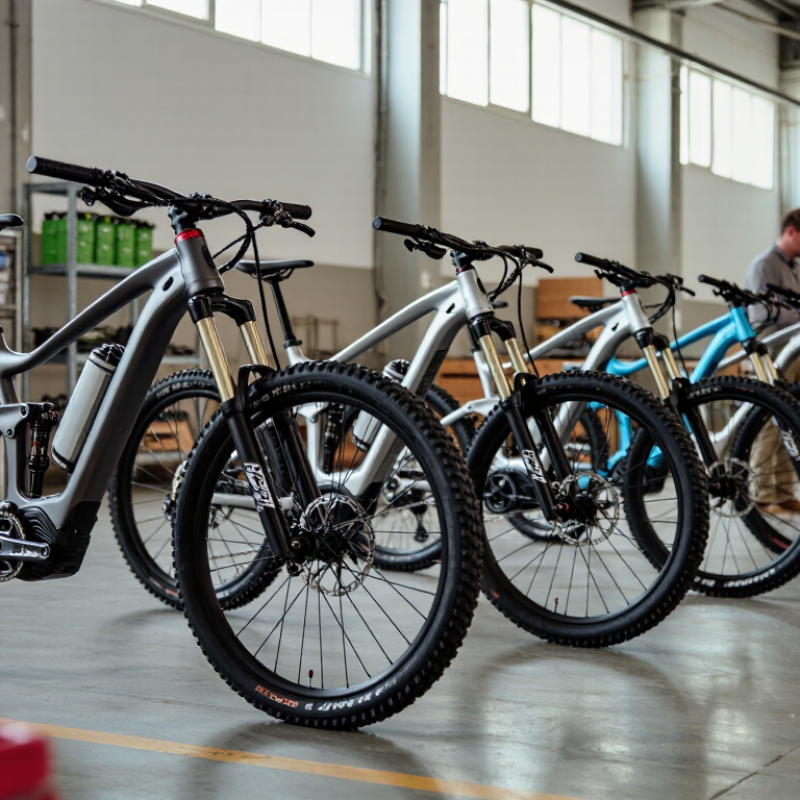
Who Are the Best Electric Mountain Bike Suppliers in China?

Types of Electric Mountain Bike Suppliers in China

China’s electric mountain bike suppliers generally fall into several groups: OEM factories, ODM developers, component-focused manufacturers, and trading companies. Their services can look similar online, but their responsibilities differ. OEM factories build bikes to a buyer’s specifications. ODM suppliers offer existing designs, often with options for frame size, paint, motor configuration, and accessories. A sample bike can reveal more than a polished catalog.

Some factories manage frame production and final assembly, while others purchase major parts from separate vendors. Ask who selects the motor, battery, brakes, and suspension, and who checks their compatibility. Request clear details on inspection steps, production capacity, and spare-part availability. Specific answers matter. A general promise of “high quality” proves little.

Trading companies can coordinate several product categories and may help with communication or mixed orders. However, they might not control factory schedules or technical changes directly. Specialist manufacturers may offer deeper product knowledge, but their customization range can be narrower. Compare a written quotation with a sample build, and check whether the stated specifications match the actual components. Even careful checks leave uncertainty; supplier documents can be incomplete, and that deserves a follow-up question.


How to Assess Supplier Quality and Manufacturing Capabilities

Assess a Chinese electric mountain bike supplier on repeatable processes, not showroom samples. A clean prototype proves little about batch consistency. Request a factory tour, production-flow chart, and recent inspection records. Watch a frame being welded, then check whether the same joint is inspected and logged on every shift. Ask how the supplier traces frames, motors, and batteries to individual production batches.

CONEBI’s 2023 European Bicycle Industry and Market Profile reports that Europe produced about 5.5 million e-bikes in 2022. That figure shows the scale of the category, but it does not certify any factory. Ask suppliers for test reports tied to the exact model and components offered. Check whether testing covers frame fatigue, braking, water exposure, and electrical-system performance. For cycle safety, confirm the relevance and scope of ISO 4210-10 testing.

Request defect rates, corrective-action records, and examples of rejected parts—not only polished certificates. Compare the supplier’s stated monthly capacity with staffing, assembly lines, and component lead times. A short sample run can reveal loose connectors, uneven welds, or inconsistent torque marks. Paperwork can still mislead. I would treat a vague answer about traceability as a real concern, even when the sample rides well.

Who Are the Best Electric Mountain Bike Suppliers in China? - How to Assess Supplier Quality and Manufacturing Capabilities

Assessment Dimension Evidence to Request Practical Assessment Benchmark Suggested Weight Supplier Score
Product compliance and market suitability Model-specific test reports, declarations of conformity, and a list of intended sales markets and applicable requirements. Confirm that documents cover the exact frame, motor, battery, and configuration being quoted. Check requirements for the destination market; requirements differ by jurisdiction. 15% — / 5
Battery safety and traceability Battery specifications, cell and pack traceability records, protection-system details, and applicable transport test documentation. Verify that the supplied battery configuration is covered by relevant evidence, such as UN 38.3 transport testing and applicable battery safety requirements. Match serial or lot records to the delivered pack. 15% — / 5
Frame and bicycle safety testing Frame material and process specifications, inspection records, and test reports for the relevant bicycle category and intended use. Ask for reports against applicable bicycle safety standards, such as the relevant parts of ISO 4210, and confirm the tested frame design matches the production model. 12% — / 5
Motor and electrical-system integration Motor and controller specifications, wiring diagrams, compatibility records, and functional-test procedures. Confirm the motor rating, assistance behavior, and configuration meet the destination market’s rules. Check that the supplier tests the complete electrical system, not only individual components. 10% — / 5
Quality management and production controls Quality-management documentation, incoming inspection plans, in-process checks, final inspection records, and corrective-action examples. Look for documented, repeatable controls with recorded results, defined defect handling, and traceability from incoming parts through final assembly. Treat a certificate as supporting evidence, not a substitute for an audit. 12% — / 5
Factory capability and process control Facility tour or audit, process flow, equipment list, staff responsibilities, production records, and subcontractor disclosures. Verify that the supplier can explain which operations are performed in-house, which are outsourced, and how outsourced processes are controlled. Confirm that the audited site is the site producing the order. 10% — / 5
Production capacity and delivery planning Recent production schedule, capacity assumptions, lead-time breakdown, order milestones, and contingency plan for constrained parts. Compare the promised schedule with documented capacity and component availability. Require written milestone dates and prompt notice of changes rather than relying on an unsupported monthly-capacity figure. 8% — / 5
Sampling and pre-shipment inspection Pre-production sample, approved specification sheet, inspection checklist, and sample inspection or test report for the order. Approve a representative sample before mass production and define inspection criteria in writing. Verify product configuration, labeling, packaging, and agreed functional checks before shipment. 8% — / 5
Warranty, spare parts, and after-sales support Written warranty terms, claim process, spare-parts list, service documentation, and response-time commitment. Check coverage periods and exclusions by component, responsibility for freight and replacement parts, and the availability of technical support. Terms should be contractual and specific to the order. 6% — / 5
Commercial transparency and document control Itemized quotation, bill of materials or configuration list, change-control procedure, and clear payment and shipping terms. Require written approval for substitutions or specification changes. Ensure the quote, approved sample, production order, and compliance documents refer to the same model configuration. 4% — / 5
Total suggested weighting 100% —

Scoring note: The weights are a suggested buyer evaluation framework, not an industry standard or a rating of any specific supplier. Score each criterion from 1 (weak evidence) to 5 (strong, verified evidence). Confirm current legal and certification requirements for the product category and destination market before placing an order.

Leading Chinese Electric Mountain Bike Suppliers to Know

Leading Chinese electric mountain bike suppliers are not defined by catalog size alone. Strong candidates usually demonstrate clear control over frame production, motor integration, battery sourcing, and final inspection. Ask for a sample build sheet, component specifications, and records from road or trail testing. Details matter. A reliable team should explain how it checks weld consistency, brake alignment, and battery connections before shipment.

During supplier discussions, request photos or video of the actual assembly line, not only studio images. Check whether staff can describe waterproofing tests and explain how replacement parts are handled. Ask about minimum order quantities, production lead times, and quality checks for each batch. The answers should be specific.

A polished brochure is not proof of consistent manufacturing, and I would treat vague claims as a reason to ask more questions. Even capable suppliers can have uneven processes, so a small trial order may reveal issues that a presentation cannot.

Compare written specifications with the delivered bike, including motor response, suspension setup, and cable routing. That takes time. It is worth it.

Comparing Models, Certifications, and Export Services

When comparing electric mountain bike suppliers in China, look beyond frame color and advertised range. Check motor output, battery capacity, brake type, suspension travel, and frame sizing against the terrain your customers ride. Ask how range was measured; rider weight, hills, temperature, and assist level can change it sharply. Numbers need context.

Certifications deserve model-by-model review. Request current certificates and test reports for the exact bike, battery, and charger configuration you plan to order. Confirm the issuing laboratory and certificate scope, rather than assuming one document covers every model. Ask whether component changes trigger new testing. Small detail, big consequence. A tidy document folder is useful, but it does not replace checking that the paperwork matches the shipment.

Export service shows up in ordinary moments. Can the supplier send a sample, provide clear packing dimensions, and share spare-parts lists before production? Ask about manuals, carton protection, warranty steps, and how quickly technical questions receive useful answers. A sample ride and inspection can reveal loose cables or awkward controls that photos miss. Still, one sample is not a full quality system. Request inspection records and agree on acceptance criteria, even if the process feels a little fussy.

How to Select a Supplier for Your Market and Budget

Who Are the Best Electric Mountain Bike Suppliers in China?
How to Select a Supplier for Your Market and Budget

CONEBI’s 2023 European Bicycle Industry and Market Profile reports about 5.1 million e-bike sales in Europe in 2022. That figure signals substantial demand, but it cannot predict sales in your specific market. Start by matching the bike’s motor output, battery capacity, suspension, and component level to local terrain and customer expectations. A trail-focused model with larger batteries may cost more to ship and service than a simpler commuter-style build.

Compare suppliers on landed cost, not just factory price. Request a sample, a detailed parts list, production lead times, warranty terms, and the cost of replacement batteries and controllers. Ask how quality checks are recorded, and verify applicable safety documentation for your destination market. A polished factory video is weak evidence, though buyers still overvalue it. One sample is useful, but it cannot reveal every production inconsistency. Check references and inspect production where practical.

Tips: Build a budget that includes freight, duties, spare parts, and after-sales support. Ask for written quotes at several order quantities, then compare like-for-like specifications. Do not stretch your budget for features customers may not notice; prioritize reliable components and accessible service parts.

Choosing an Electric Mountain Bike Supplier: Motor-Power Limits by Market

Compare the maximum rated motor power specified by three market regulations. Confirm local requirements before placing a supplier order.

How to use this: Check that the supplier can configure and document a bike to meet your destination market’s rules. Higher-power models may not qualify as street-legal electric bicycles, and U.S. state requirements vary.

Sources: EU Regulation (EU) No 168/2013; China standard GB 17761-2018; U.S. Consumer Product Safety Commission definition of a low-speed electric bicycle. Values are rated motor-power limits, not supplier performance ratings.