
Choosing a Marble Cutting Disc supplier requires more than comparing prices and product photos. Natural stone varies in hardness, thickness, veining, and moisture content. A disc that cuts cleanly through soft Carrara marble may struggle with denser stone. This guide examines ten suppliers worldwide through practical factors, including cutting performance, diamond segment design, rim stability, heat control, and service consistency.
The evaluation considers product specifications, manufacturing experience, quality systems, and feedback from professional stone fabricators. Attention is given to wet and dry cutting options, common sizes, arbor compatibility, and expected service life. A reliable supplier should provide clear technical data, realistic cutting recommendations, and responsive support. Small details matter. A stable blade can reduce chipping around a polished edge, while poor bonding may leave rough marks after only a few cuts.
No supplier is perfect. That matters.
Performance also depends on the machine, operator technique, water flow, and marble type. Therefore, this list should support careful purchasing rather than replace site testing. Where information is limited, that limitation is noted instead of treated as proof of quality. Readers can use these comparisons to identify suitable suppliers, request samples, and verify claims before placing a large order. The strongest choice is not always the cheapest or most famous. It is the supplier whose disc performs consistently under the conditions you actually face.
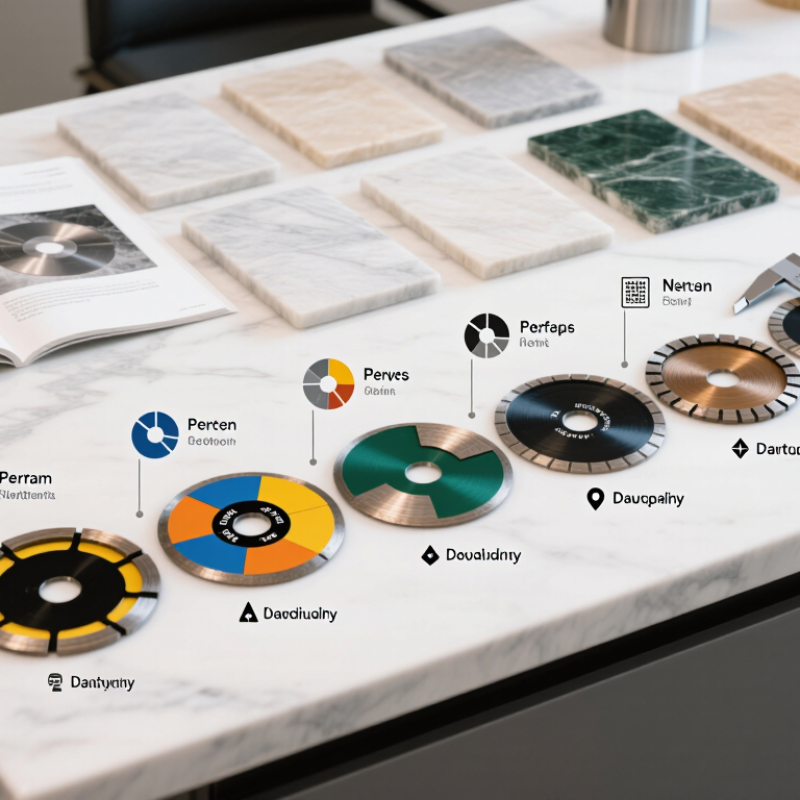
Marble cutting discs are circular tools with diamond particles fixed inside a metal rim or segmented edge. The diamonds perform the cutting; the steel body provides stability. As the disc rotates, exposed diamond grains scratch and fracture the marble surface. The bond then wears gradually, revealing fresh cutting particles. This process explains why a disc can cut smoothly at first, then slow down when its bond becomes glazed.
Disc design affects accuracy, heat, and edge quality. Continuous rims usually produce cleaner cuts, while segmented rims remove material faster. Water cooling reduces heat and carries abrasive dust away from the kerf. Dry cutting remains possible, but it demands shorter passes and careful dust control. Incorrect feed pressure can chip a polished edge. I have seen this mistake repeatedly: more force feels productive, yet it often damages the slab.
Market data shows why disc selection matters. Grand View Research estimates the global diamond tools market reached about USD 8.6 billion in 2023, supported strongly by construction demand. The U.S. Geological Survey’s 2024 Mineral Commodity Summaries also records substantial dimension-stone production, confirming steady demand for precision cutting equipment. These figures do not guarantee performance. Arbor size, machine speed, marble hardness, water flow, and operator technique must match the disc specification. Small details matter.

Choosing among the top 10 marble cutting disc suppliers worldwide requires more than comparing prices. Performance begins with material knowledge. Marble varies in hardness, veining, moisture, and fracture behavior. Experienced suppliers should explain suitable diamond grit, bond hardness, segment geometry, and arbor size for each application.
Market data supports careful evaluation. Grand View Research estimated the global diamond tools market at about USD 8.1 billion in 2023, with continued growth expected through 2030. This expansion increases supplier choice, but not necessarily product consistency. Ask for cutting-speed records, kerf-loss measurements, and lifespan tests on comparable marble. A reliable supplier can provide batch traceability, technical drawings, inspection records, and clear tolerances. Short answers are a warning.
Safety and quality systems also deserve attention. ISO 9001 certification can indicate controlled production, although certification alone proves little about cutting results. The European Commission’s Product Environmental Footprint work highlights growing pressure to measure resource use and manufacturing impacts. Therefore, evaluate water requirements, dust-control guidance, packaging, and disc disposal information. These details affect operating cost.
Request samples before placing a large order. Test them on real slabs, not only laboratory coupons. Record cuts per disc, cutting time, edge chipping, noise, and operator feedback. Suppliers should discuss failures honestly. That matters. Some published performance claims are difficult to reproduce in different workshops. A disciplined trial, with written results, may reveal that the cheapest disc is not the most economical choice.
This weighted procurement framework focuses on measurable factors commonly used when comparing marble cutting disc suppliers. Product consistency and cutting performance receive the highest priority, while technical support, compliance, logistics, and commercial terms help reduce supply and operational risks.
Top 10 Marble Cutting Disc Suppliers Worldwide
Regional Overview of the Worldwide Supplier Market
The worldwide marble cutting disc market follows construction, renovation, and natural stone processing demand. The World Bank reports that about 56% of the global population lived in urban areas in 2021. This share may reach nearly 70% by 2050. That shift supports steady demand for reliable stone-cutting tools.
Asia remains the largest manufacturing and consumption region. China and India offer broad supplier networks, competitive pricing, and many disc specifications. Europe emphasizes precision, safety testing, and lower-vibration designs. Italy, Spain, and Germany remain influential in stone-processing equipment. North American buyers often value certification, stable supply, and technical support. The Middle East shows demand from hospitality and commercial construction, although project cycles can be uneven. According to the International Trade Centre’s Trade Map, global trade in abrasive tools under HS 6804 involves substantial cross-border movement, but trade values vary sharply by country and product classification. The data is useful, yet not perfectly marble-specific.
Tips: Compare cutting speed, segment height, core strength, and cooling requirements. Ask for test results using your actual marble type. Calcareous marble can react differently from harder varieties. Do not judge quality by price alone.
Supplier rankings also need caution. A disc performing well in a factory may fail on a portable machine. Field trials, batch consistency, and documented safety procedures provide stronger evidence than catalogue claims. Procurement teams should review delivery times, replacement policies, and technical training before choosing regional suppliers.
| Rank | Supplier Region | Manufacturing Base | Export Orientation | Product Breadth | Common Disc Sizes | Typical Bond Options | Quality Standard Focus | Marble Application Fit |
|---|---|---|---|---|---|---|---|---|
| 1 | East Asia China | Very High Large-scale abrasive and diamond-tool production | Very High Broad global distribution coverage | High-volume standard discs, segmented blades, turbo rims, and custom specifications | 105–400 mm for portable and masonry equipment; larger industrial formats also available | Sintered, electroplated, laser-welded, and vacuum-brazed | ISO-based quality systems; application-specific safety testing | Very High |
| 2 | Southern Europe Italy | High Established stone-processing machinery ecosystem | High Strong presence in premium stone-tool markets | Premium sintered blades, continuous rims, profiling tools, and engineered systems | 115–350 mm for workshops; larger discs for bridge saws and production lines | Sintered and laser-welded; specialized formulations for natural stone | CE conformity, ISO 9001 practices, and process traceability | Very High |
| 3 | Mediterranean Region Turkey | High Strong domestic natural-stone supply chain | High Significant stone-sector export activity | Quarry blades, bridge-saw discs, gang-saw tooling, and fabrication discs | 250–1,600 mm across workshop and quarry applications | Sintered and laser-welded segments; customized stone-specific bonds | ISO-oriented production and export-market compliance | Very High |
| 4 | Western Europe Germany | High Precision engineering and industrial tooling | High Advanced industrial distribution network | Precision cutting discs, specialty diamond tools, and engineered custom solutions | 100–400 mm for fabrication; industrial sizes supplied for automated equipment | Electroplated, sintered, laser-welded, and resin-bonded systems | Strict product safety, dimensional control, and documented testing | Very High |
| 5 | South Asia India | High Growing diamond-tool and stone-processing sector | High Expanding supply to regional and overseas markets | Economy and mid-range discs, granite and marble blades, and private-label production | 105–450 mm for handheld, tile-saw, and workshop equipment | Sintered, electroplated, and laser-welded | ISO-based systems and destination-market certification requirements | High |
| 6 | East Asia South Korea | High Technology-oriented abrasive manufacturing | Medium–High Focused export and industrial supply channels | High-consistency diamond discs, precision blades, and specialized cutting tools | 105–400 mm for fabrication and industrial cutting applications | Electroplated, sintered, and laser-welded | Strong dimensional consistency and industrial quality-control practices | High |
| 7 | East Asia Japan | Medium–High Precision manufacturing and materials expertise | Medium Selective premium export channels | Precision discs, thin-kerf blades, specialty bonds, and low-vibration products | 100–305 mm for precision fabrication and compact professional equipment | Electroplated, resin-bonded, and advanced sintered formulations | High process control, safety compliance, and product consistency | High |
| 8 | North America United States | Medium–High Specialized tooling and professional distribution | Medium Strong domestic market with selected exports | Professional-grade blades, restoration tools, bridge-saw discs, and custom products | 105–450 mm for fabrication; larger sizes available for industrial saws | Sintered, laser-welded, electroplated, and vacuum-brazed | ANSI, OSHA-related workplace requirements, and safety testing | High |
| 9 | Southwestern Europe Spain | Medium–High Integrated ceramic and natural-stone tooling expertise | Medium–High Established European and Mediterranean trade links | Marble and granite blades, bridge-saw tools, polishing systems, and fabrication discs | 115–400 mm for workshops; larger industrial formats supplied on request | Sintered, laser-welded, and electroplated | CE conformity, ISO practices, and European safety requirements | High |
| 10 | South America Brazil | Medium Domestic stone industry with developing tooling capacity | Medium Primarily regional distribution with selected exports | General-purpose diamond blades, quarry tools, fabrication discs, and replacement segments | 105–400 mm for workshops and 250–1,200 mm for industrial stone cutting | Sintered and laser-welded; application-specific segment designs | Local regulatory compliance and ISO-oriented manufacturing practices | Medium–High |
A practical top ten should reflect real purchasing needs, not advertising claims. The precision OEM supplier offers custom diameters and controlled tolerances. The high-volume manufacturer provides stable output for large contractors. The premium diamond specialist focuses on clean edges and longer service life. The regional producer often delivers faster replacement stock. The stone-fabrication supplier understands marble hardness, veining, and fragile corners.
The value-focused supplier keeps costs controlled for routine renovation work. The industrial supplier supports heavy bridge saws and continuous cutting. The small-batch specialist adapts quickly to unusual disc specifications. The export-oriented supplier usually handles packaging, documentation, and international logistics well. The testing-led supplier stands out through batch records, blade inspection, and cutting trials. Small details matter.
Experienced buyers should request samples before placing large orders. A good disc should cut smoothly, resist excessive vibration, and leave limited chipping on polished marble. Ask about diamond concentration, segment bonding, core flatness, recommended RPM, and wet-cutting requirements. Clear answers show technical competence. Vague promises do not.
Supplier performance can change between batches. That is easy to overlook. I would compare cutting speed, edge quality, noise, and disc wear under identical conditions. A supplier may offer an excellent first sample yet struggle with repeat consistency. Independent testing is not excessive; it is practical risk control. Safety instructions and machine compatibility should also be verified before use.
Selecting a marble cutting disc supplier requires more than comparing prices. Match the disc to marble hardness, thickness, cutting speed, and machine power. Ask for test data, not only catalog claims. A reliable supplier should provide rim specifications, operating limits, batch traceability, and clear warranty terms. Request samples and inspect the cut edge under strong light. Chipping, glazing, or excessive heat reveals problems quickly.
Safety must influence the decision. OSHA limits respirable crystalline silica exposure to 50 micrograms per cubic meter over an eight-hour shift. Its action level is 25 micrograms. Therefore, suppliers should recommend wet-cutting systems or effective dust-control methods. The U.S. Geological Survey’s 2024 Dimension Stone summary also links stone demand with construction activity, supporting the need for consistent production capacity. Market forecasts from Grand View Research identify construction and stone processing as major growth drivers for diamond tools through 2030. However, forecasts do not guarantee delivery. Confirm stock, lead times, and replacement availability directly.
Tips: Compare three samples on the same saw. Record cutting time, water use, noise, and edge quality. Check whether the supplier follows applicable abrasive-tool safety standards. Price matters. It can mislead. A cheaper disc may create more waste, downtime, and polishing work. Ask for recent batch records and independent test results. One overlooked detail remains important: technical support after purchase. A supplier who adjusts specifications after field feedback is usually more dependable than one offering only the lowest quotation.
