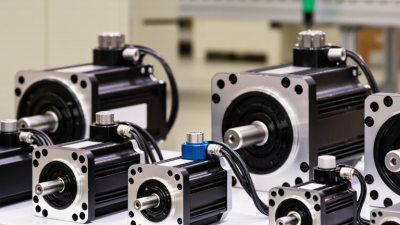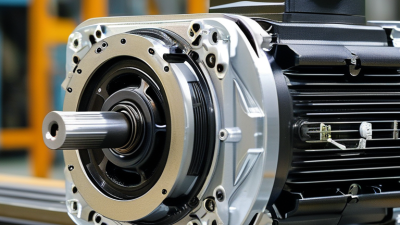
Choosing among the best DC servo motor manufacturers in China takes more than comparing prices and catalog specifications. A Dc Servo Motor must match your machine’s torque, speed, feedback, and operating conditions. Details matter. For packaging equipment, stable low-speed motion can reduce positioning errors. For automated inspection, encoder resolution and repeatability deserve close attention. A low purchase price can lose its appeal when overheating interrupts production.
James Clerk Maxwell, a foundational expert in feedback control, described the principle behind reliable speed regulation in his paper “On Governors”: “A governor is a part of a machine by means of which the velocity of the machine is kept nearly uniform, notwithstanding variations in the driving-power or the resistance.” That principle remains relevant when assessing modern servo systems under changing loads. Test under load. Ask manufacturers for torque-speed curves, continuous-duty ratings, encoder specifications, and compatible drive documentation. Request test conditions alongside performance figures, including ambient temperature, supply voltage, and duty cycle. These details help distinguish measured capability from optimistic marketing.
This guide approaches Chinese manufacturers through practical selection criteria: application fit, documented performance, production consistency, customization, and technical support. Certifications deserve scrutiny; verify their scope, validity, and relevance to the product being purchased. Samples help. Still, one successful sample cannot establish consistency across future production batches. An imperfect shortlist may need revision after thermal testing or integration trials. The strongest supplier choice is one supported by evidence from your actual operating requirements.
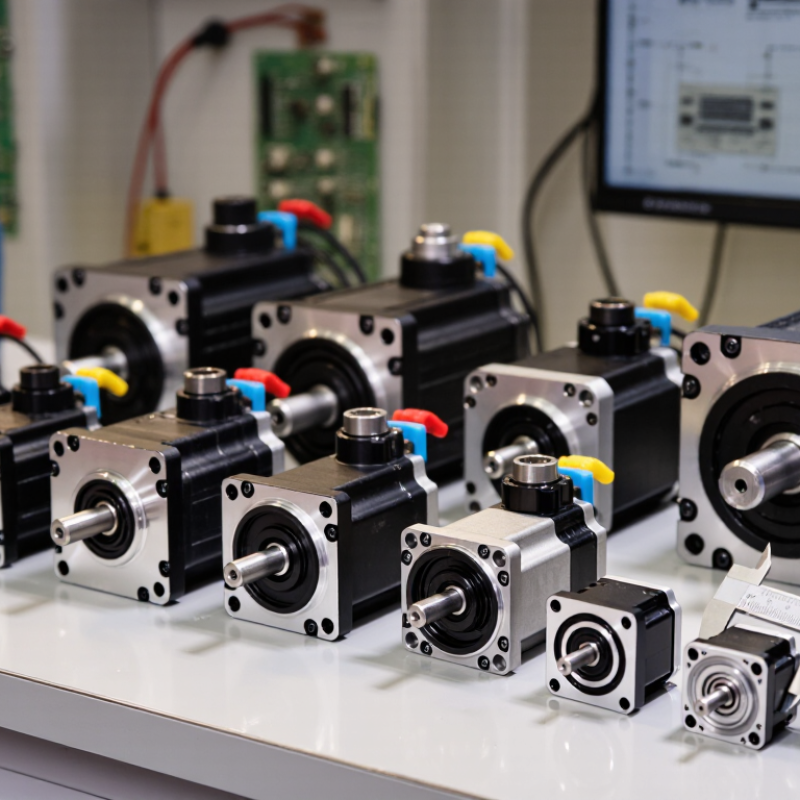
DC servo motors use feedback to control position, speed, or torque. An encoder measures shaft movement, while the drive adjusts current to correct errors. Brushed designs switch current mechanically through carbon brushes and a segmented commutator. This arrangement simplifies commutation and can suit smaller positioning systems with modest duty cycles. However, brush contact creates friction, electrical noise, and wear particles. Maintenance still matters. In a packaging machine running frequent start-stop cycles, brush access deserves attention before installation.
Brushless servo motors replace mechanical commutation with electronic switching controlled by rotor position signals. Their drives convert DC supply power into timed currents through the stator windings. Permanent magnets on the rotor interact with these fields to generate torque. Without brushes, these motors generally need less routine maintenance and can support demanding acceleration profiles. Yet brushless does not automatically mean better positioning accuracy. Encoder resolution, mechanical backlash, drive tuning, and mounting stiffness all influence the result. A poorly tuned brushless axis can still overshoot its target.
When comparing Chinese manufacturers, request torque-speed curves, continuous torque ratings, and clearly stated test conditions. Check the evidence. For example, a 48 V winding rated at room temperature may perform differently inside a warm enclosure. Ask whether quoted torque is continuous or briefly available during acceleration. Brushless designs often look preferable on paper, but a serviceable brushed motor may fit an intermittent application better.
Brushed DC servo motors use brushes and a mechanical commutator to switch current within the rotor. Brushless DC servo motors use an electronic drive to switch current between stator windings. The chart illustrates ideal current waveforms during steady operation.
Brushed DC: With an ideal regulated current command, the current at the motor terminals stays constant. The mechanical commutator reverses current in individual rotor coils as the rotor turns, allowing torque to continue acting in the commanded direction.
Brushless DC: In ideal six-step commutation, each stator phase carries positive current for 120 electrical degrees, remains unenergized for 60 degrees, carries negative current for 120 degrees, and remains unenergized for another 60 degrees. The other two phase waveforms are displaced by 120 electrical degrees.
Values represent ideal theoretical waveforms, not manufacturer measurements. Current is normalized to the commanded current magnitude: 1 p.u. = 100%. The two traces show different measurement points: brushed motor terminal current and one brushless motor phase current. Actual waveforms include switching ripple and finite commutation transitions. Brushless servo drives using sinusoidal commutation produce different phase-current waveforms. Electrical angle equals mechanical angle multiplied by the number of pole pairs.
Choosing among DC servo motor manufacturers in China requires more than comparing rated power. For 24 V and 48 V systems, check the motor, drive, and power supply as a matched package. A 24 V setup often suits compact positioning mechanisms with modest speed requirements. A 48 V system provides more voltage headroom, helping maintain torque at higher speeds when correctly matched. Voltage alone proves little. Compare torque-speed curves at your actual supply voltage, including expected cable and drive losses.
Current deserves close attention. A 200 W electrical input corresponds to approximately 8.3 A at 24 V or 4.2 A at 48 V. These figures describe supply-side averages; winding current and acceleration peaks can differ substantially. Ask for continuous torque, peak torque duration, winding resistance, and thermal test conditions. Check the fine print. An impressive torque figure may depend on a mounting plate that dissipates more heat than your machine can.
Feedback and protection specifications also affect practical performance. Request encoder resolution, position accuracy, communication interfaces, and drive fault thresholds. Encoder counts alone do not establish positioning accuracy; coupling stiffness and mechanical backlash also matter. Regenerative braking needs attention, especially when a vertical axis lowers a load into a supply that cannot absorb returned energy. A short bench trial is useful, but imperfect: it may miss heat buildup during repeated cycles. Ask manufacturers for temperature-rise records and test a representative motion cycle with your intended load.
When comparing DC servo motor manufacturers in China, encoder specifications deserve more scrutiny than a simple bit count. A 17-bit encoder provides 131,072 positions per revolution, corresponding to approximately 9.89 arcseconds per count. A 23-bit encoder provides 8,388,608 positions, or approximately 0.154 arcseconds per count. That is 64 times finer nominal resolution. Resolution is not accuracy. Encoder calibration, shaft eccentricity, electrical noise, and mechanical backlash can all limit usable positioning performance. Higher resolution cannot remove these errors.
17-bit feedback
76 nanometers
Theoretical travel increment
23-bit feedback
1.2 nanometers
Theoretical travel increment
A useful benchmark compares both feedback options under identical speed, load, temperature, and controller settings. Consider a positioning stage using a screw with 10 mm travel per revolution. The theoretical travel increments are approximately 76 nanometers for 17-bit feedback and 1.2 nanometers for 23-bit feedback. These figures describe quantization, not achievable stage accuracy. Measure actual travel using an independent instrument with suitable uncertainty. Test repeated approaches from both directions to expose backlash and hysteresis. Record settling time, overshoot, and standstill position variation alongside encoder counts.
For supplier evaluation, request documented encoder accuracy, feedback update rates, and repeatability results under stated conditions. Check the mechanics. A compliant coupling can overwhelm the apparent benefit of additional feedback bits. Higher resolution may improve low-speed control when the drive can use that information effectively. However, a short bench test may miss thermal drift during a full production shift. That limitation deserves explicit documentation before choosing the feedback specification.
China’s DC servo motor manufacturers serve applications ranging from compact inspection equipment to automated assembly lines. The International Federation of Robotics’ World Robotics 2024 report recorded 276,288 industrial robot installations in China during 2023. That represented 51% of global installations. These figures indicate substantial automation demand, although they do not rank motor suppliers or establish product quality. For buyers comparing Chinese manufacturers, useful distinctions include low-voltage product availability, encoder options, documentation quality, and technical support. Specifications need context.
A strong shortlist starts with application requirements: supply voltage, continuous torque, peak current, operating speed, and available installation space. For example, a 48 V inspection axis may need smooth low-speed motion more than high maximum speed. Request torque-speed curves at your actual supply voltage, alongside thermal limits and compatible drive specifications. Check terminology carefully. Some suppliers group brushless DC motors and permanent-magnet AC servos together, despite differences in commutation and control. A low purchase price looks attractive, but I would question savings that depend on undocumented overload ratings.
Tips: Ask shortlisted factories to demonstrate your motion profile with the intended load and cable length. Record positioning error, settling time, case temperature, and fault behavior during repeated acceleration. A short demonstration can miss overheating; test until temperatures stabilize under representative conditions. Request written warranty terms and replacement lead times before ordering production quantities.
Selecting a DC servo motor manufacturer in China requires more than comparing rated power and factory photographs. Ask for documented ratings against the applicable edition of IEC 60034-1. Check rated voltage, current, speed, duty type, insulation class, and declared operating conditions. Details matter. A motor rated for continuous duty may still overheat inside a compact enclosure with restricted airflow. Request temperature-rise test results that identify mounting conditions, ambient temperature, load, and cooling arrangements.
IEC 60034-1 provides a framework for motor ratings and performance, but it does not establish positioning accuracy. Evaluate the complete motor, encoder, and drive combination against your actual motion profile. For a packaging axis, share acceleration ramps, peak torque duration, cycle frequency, and holding requirements. Ask the supplier to explain how these conditions affect winding temperature and available torque. Request a sample test report with traceable serial numbers and clearly stated acceptance limits. One report is insufficient. A sample can pass while production consistency remains uncertain.
Technical support should be evaluated before placing a volume order. Confirm who handles encoder wiring, drive tuning, replacement parts, and failure analysis. Request a realistic response window, such as two working days for an initial technical assessment. That target may need adjustment across time zones; the escalation process deserves equal attention. A pilot batch adds cost, but it can expose connector mismatches or thermal assumptions before installation.
Use this technical evaluation table to compare suppliers in China using documented motor ratings, application requirements, and service capabilities.
| Evaluation Dimension | Verified Technical Basis | Evidence to Request | Selection Guidance |
|---|---|---|---|
| Motor Type and Standard Applicability | IEC 60034-1 addresses ratings and performance of rotating electrical machines within its scope. A DC-powered servo system may use a brushed DC motor or an electronically commutated motor. | Motor construction, commutation method, drive requirements, and the applicable standard edition with any exclusions identified. | Confirm the actual motor technology before comparing ratings. A shared DC supply voltage does not establish equivalent motor construction or performance. |
| Rated Power, Torque, and Speed | Mechanical shaft power follows P = T × n / 9550, where P is in kW, T is in N·m, and n is in r/min. The values must refer to the same operating point. | Rated output power, rated torque, rated speed, torque-speed curves, and stated cooling and mounting conditions. | Compare continuous operating points under equivalent conditions. Treat peak torque and peak power as separate, time-limited capabilities. |
| S1 Continuous Duty |
IEC 60034-1: S1 Operation at a constant load for sufficient time to reach thermal equilibrium. |
Continuous torque and current ratings, temperature-rise results, ambient conditions, and the test mounting arrangement. | Use the continuous rating to assess sustained loads. Check whether the published rating depends on an external heat sink or forced cooling. |
| S2 Short-Time Duty |
IEC 60034-1: S2 Operation at a constant load for a specified time shorter than that needed to reach thermal equilibrium, followed by sufficient rest to cool. |
The declared operating duration, load, initial thermal conditions, and required cooling interval. | A short-time rating cannot be treated as a continuous rating. Match both the permitted running time and recovery conditions to the application. |
| S3 Intermittent Periodic Duty |
IEC 60034-1: S3 A sequence of identical cycles containing constant-load operation and rest. Starting does not significantly affect temperature rise. |
Cyclic duration factor, cycle duration, operating load, and confirmation that starting losses are thermally insignificant. | For frequent acceleration or electric braking, verify whether another duty designation or a detailed load-cycle analysis is appropriate. |
| Insulation and Thermal Limits | IEC 60085 thermal classes include B: 130°C, F: 155°C, and H: 180°C. These class temperatures are not interchangeable with allowable ambient temperature or motor-case temperature. | Insulation-system class, permissible winding temperature rise, measurement method, temperature-sensor details, and protection settings. | Evaluate winding temperature limits together with ambient temperature and cooling. A higher insulation class alone does not establish higher continuous output. |
| Environmental Conditions | Ambient temperature, altitude, cooling method, and heat transfer through the mounting structure affect motor thermal performance. | Permitted operating temperature and altitude, derating curves, cooling requirements, and installation instructions. | Obtain ratings for the actual installation conditions, particularly for enclosed spaces, elevated ambient temperatures, or high-altitude operation. |
| Enclosure Protection | IEC 60034-5 addresses IP protection classifications for rotating electrical machines. IP54 indicates dust protection and protection against splashing water; IP65 indicates dust-tight construction and protection against water jets. | The declared IP rating, supporting test documentation, and the scope of protection for the shaft, connectors, and cable entries. | Match enclosure protection to the installation. An IP rating alone does not establish resistance to corrosion, cleaning chemicals, or condensation. |
| Peak Torque and Drive Matching | Peak torque depends on motor current limits, magnetic and thermal constraints, and drive capability. Peak torque duration is application- and product-dependent. | Peak torque duration, current convention, torque constant, drive current limits, supply requirements, and regenerative braking provisions. | Compare ratings using consistent current definitions, such as RMS or peak where applicable. Verify that the motor-drive combination can execute the required acceleration and braking cycle. |
| Feedback and Motion Performance | Encoder resolution, encoder accuracy, and achieved positioning accuracy are distinct specifications. System performance also depends on mechanics, control tuning, and load. | Feedback type, resolution, accuracy, interface protocol, repeatability data, and test conditions. | Verify compatibility with the intended drive and controller. Request application-level positioning evidence when accuracy is critical. |
| Test Records and Traceability | A statement of IEC 60034-1 conformity does not by itself establish independent certification or verify every advertised performance value. | Model-specific test reports, serial-number traceability, test conditions, measurement methods, and any claimed third-party certification. | Prefer evidence tied to the quoted motor configuration. Check that reports cover the relevant winding, feedback device, cooling arrangement, and rated duty. |
| Technical Support and Lifecycle Service | Warranty terms, response times, spare-parts availability, and repair arrangements are supplier commitments; IEC 60034-1 does not assign supplier service rankings. | Written warranty coverage, support response targets, commissioning assistance, repair procedures, spare-parts lead times, and product-change notification terms. | Evaluate documented commitments against operational needs. For brushed DC motors, include brush inspection intervals and replacement-part availability. |
Comparison basis: This table presents factual evaluation criteria, not measured results or rankings for individual manufacturers. Supplier performance must be established from product-specific documentation and testing.
Standards referenced: IEC 60034-1, Rotating electrical machines — Rating and performance; IEC 60034-5, Degrees of protection provided by the integral design of rotating electrical machines; IEC 60085, Electrical insulation — Thermal evaluation and designation. Confirm the applicable editions and product scope when specifying compliance.